Save the Date vs Wedding Invitation: What Belongs on Each?
The difference between a save the date vs wedding invitation comes down to purpose and timing. A save-the-date gives intended guests enough notice to reserve the day and begin making travel plans. The invitation arrives later with the finalized event details, response instructions, and any information guests need to attend.
Many couples benefit from sending both, especially when guests will travel, the wedding falls near a holiday, or the celebration involves several events. But they are not interchangeable: the first is an early calendar notice, while the second is the formal request for attendance.
Save the date vs wedding invitation at a glance
| Decision | Save-the-date | Wedding invitation |
|---|---|---|
| Primary purpose | Ask intended guests to reserve the date | Invite guests and provide attendance details |
| Typical timing | About 3–6 months before the wedding, or earlier when circumstances require | About 6–8 weeks before the wedding |
| Information depth | Names, date, general location, and optional website | Names or host information, date, time, venue, and RSVP instructions |
| RSVP | Usually not requested | Normally requested through a reply card, website, email, or phone |
| Guest-list stage | The intended invitee list should be stable | The final invitation list and household details should be confirmed |
| Format | Printed card or informal digital notice | Printed invitation is preferable for most weddings, though formats can vary |
| Design role | Introduces the visual direction | Establishes or completes the main stationery suite |
The timing above reflects the general planning guidance from the Emily Post wedding-planning timeline, which places save-the-dates around three to six months ahead and invitations around six to eight weeks ahead. Earlier notice can be reasonable when guests face substantial travel or scheduling demands.
When should you send each piece?
Treat the standard timeline as a planning baseline rather than an inflexible deadline. For a local wedding with a straightforward ceremony and reception, the usual window may be sufficient. More lead time can help when guests need flights, lodging, time away from work, or winter-driving plans.
That can be particularly relevant for a Utah mountain wedding, a celebration near a holiday weekend, or an event in a destination where lodging fills quickly. Send early enough to make planning realistic, but avoid announcing a date before the intended guest list is dependable.
The invitation should follow after the core details are settled. Before printing, confirm the date, start time, venue name, complete address, RSVP method, and response deadline. If the celebration includes a ceremony, reception, open house, or separate family meal, make sure each guest receives only the details that apply to that person.
What belongs on a save-the-date?
A save-the-date should be brief. Its job is to communicate the information guests need for calendar and travel planning, not to reproduce the entire invitation suite.
- The couple’s names
- The wedding date
- The city and state, if known
- A wedding website, if it is ready and useful
- A short line such as “Invitation to follow”
If the precise venue or ceremony time is not final, do not guess. A general location such as “Park City, Utah” or “Salt Lake City, Utah” can still help guests evaluate travel. The later invitation can provide the venue and time once contracts and schedules are confirmed.
A save-the-date usually does not need an RSVP. If you need an early travel estimate, you can invite guests to share preliminary plans through the wedding website, but make it clear that this is not the formal response. Avoid presenting tentative answers as a final headcount.
Simple save-the-date wording
A practical version might read: “Save the date for the wedding of Maya Chen and Daniel Ortiz, September 19, 2027, Moab, Utah. Invitation to follow.” If the website contains reliable travel information, add its address beneath that line.
What belongs on a wedding invitation?
The wedding invitation carries the information guests use to decide, respond, and arrive at the correct place. It also helps establish expectations about the event, from its level of formality to whether the invitation covers a ceremony, reception, or both.
- The hosts or couple, according to the wording style you choose
- A clear invitation line
- The couple’s names
- The wedding date and start time
- The venue name and location
- Reception information when applicable
- RSVP instructions and a response deadline
Keep the main card readable rather than forcing every logistical note onto it. Directions, lodging, transportation, attire guidance, and details for additional events can go on an enclosure card or wedding website. A more complex celebration may benefit from a coordinated suite with separate cards for distinct groups of guests.
Addressing is part of the invitation’s communication. The envelope indicates exactly who is included, including spouses, partners, or children where applicable. Review the household list before ordering envelopes, using guidance for situations such as addressing wedding invitations to married couples or addressing a widowed guest respectfully.
Do you need to send both?
Send both when advance notice will materially help your guests. This is often the better choice for destination weddings, travel-heavy guest lists, holiday weekends, and dates during busy school or vacation periods. The save-the-date creates planning time; the invitation later provides the confirmed instructions.
You may be able to skip save-the-dates for a small, local wedding planned on a short timeline, particularly if you have already spoken directly with every guest. Do not skip the invitation merely because people know the date. Guests still need a dependable record of the time, place, attendance scope, and response method.
Finalize the intended list before sending save-the-dates. Guests reasonably interpret one as a strong indication that an invitation will follow. Although circumstances can change, using save-the-dates as casual announcements before making guest-count decisions can create confusion and hurt feelings.
Printed, digital, or a mix?
A digital save-the-date paired with a printed invitation can be a sensible combination. Emily Post considers email appropriate for informal save-the-date notices while indicating that printed invitations are preferable for most weddings. This approach can provide quick notice while preserving the formality and physical presence of the main invitation.
Choose the format according to the guest list as well as the budget. Printed save-the-dates can feel more intentional and are easier for some recipients to keep visible. Digital notices are fast, but outdated email addresses, spam filters, and guests who rarely use email can reduce their reliability. A mixed approach is reasonable when different households communicate in different ways.
The designs should coordinate, not necessarily match
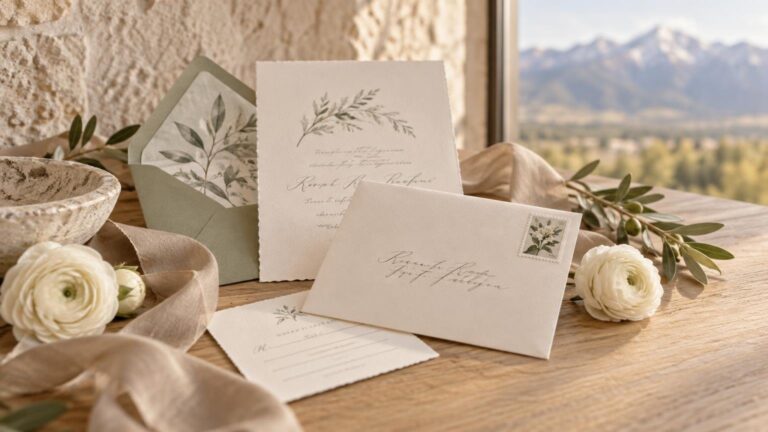
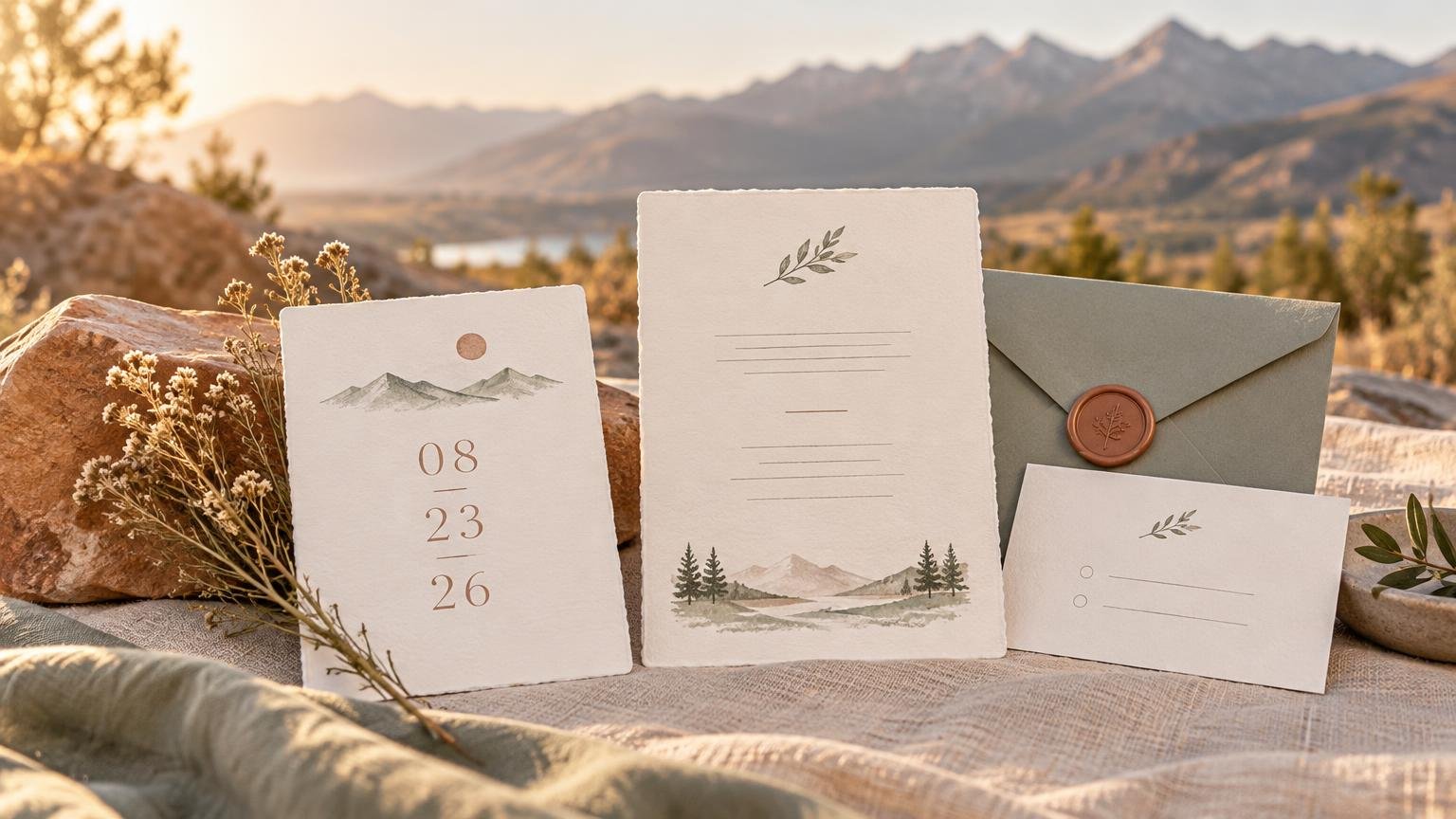
Save-the-dates and invitations do not need identical layouts. They should feel intentional when viewed together, but coordination can be as subtle as repeating a color, typeface, illustration style, paper tone, or location motif.
- Exact match: Use the same typography, colors, and artwork across both pieces.
- Coordinated evolution: Introduce one visual element on the save-the-date, then expand it across the invitation and enclosure cards.
- Intentional contrast: Use a casual photograph or illustration first, followed by a more formal invitation tied together by color or wording tone.
If the printing process is the main design feature, compare options before committing the entire suite. For example, foil and letterpress create distinctly different surfaces and moods. Couples who want flexibility can print the save-the-date more simply and reserve a premium process for the invitation.
Prepare the complete suite before ordering or mailing
Proof each item in context, not as an isolated design. Confirm that names, dates, times, addresses, website links, and response deadlines agree across the cards and website. Check the envelope size, card orientation, insert order, and readable type size before approving production.
When you are ready to move from design to production, review options for printing save-the-dates and wedding invitation suites with the final quantity, card sizes, paper choices, envelopes, and proofing needs in mind. Order enough for the guest households, not the number of individual guests, then add extras for late additions, addressing mistakes, keepsakes, and photography. If cost is a concern, prioritize readable design and careful proofing before decorative upgrades; this guide to saving money on wedding invitations explains where simplifying can have the least visual impact.
Check the assembled mailpiece
Postage cannot be determined reliably from the flat card dimensions alone. USPS explains that mailability and postage depend on the finished piece’s size, shape, weight, thickness, and flexibility. Square, rigid, bulky, or unusually shaped pieces may require nonmachinable handling.
Assemble one complete invitation exactly as a guest will receive it, including every insert and embellishment. Then weigh and measure that finished sample and take it to a postal counter if there is any uncertainty. USPS also advises placing invitations with external wax seals, string, ribbon, or similar decoration inside another envelope to protect them during processing.
Make each mailing do one clear job
Use the save-the-date to give intended guests useful planning time. Use the wedding invitation to deliver confirmed attendance information and collect responses. When both pieces have distinct jobs, you can keep the wording cleaner, make design decisions more deliberately, and avoid asking an early announcement to carry details that are not yet final.
Start by stabilizing the guest list and wedding date. Then choose the save-the-date format, map the invitation timeline backward from the RSVP deadline, and proof one fully assembled suite before ordering or purchasing postage.
Frequently Asked Questions
What is the difference between a save-the-date and a wedding invitation?
A save-the-date is an early notice that helps intended guests reserve the day and plan travel. The invitation follows with confirmed event details, attendance information, and RSVP instructions.
Do you need to send both?
Sending both is useful when guests need advance notice for travel, holiday schedules, or a multi-event celebration. A small local wedding on a short timeline may not need save-the-dates, but guests still need a dependable invitation with the final details.
When should save-the-dates and invitations be sent?
General guidance suggests sending save-the-dates about 3–6 months before the wedding and invitations about 6–8 weeks before it. Earlier notice may be appropriate when travel or scheduling is more demanding.
Does a save-the-date need an RSVP or exact venue?
Usually, no RSVP is needed. If the venue or ceremony time is not confirmed, include a general location rather than guessing, then provide the finalized venue and time on the invitation.
Can you send a digital save-the-date and a printed invitation?
Yes. Email can be appropriate for an informal save-the-date, while printed invitations are preferable for most weddings. Consider whether email will reliably reach every household.
How should you check postage for a wedding invitation?
Assemble, weigh, and measure one complete invitation with every insert and embellishment. Mailability and postage depend on the finished piece’s size, shape, weight, thickness, and flexibility; square, rigid, bulky, or externally embellished pieces may need special handling.