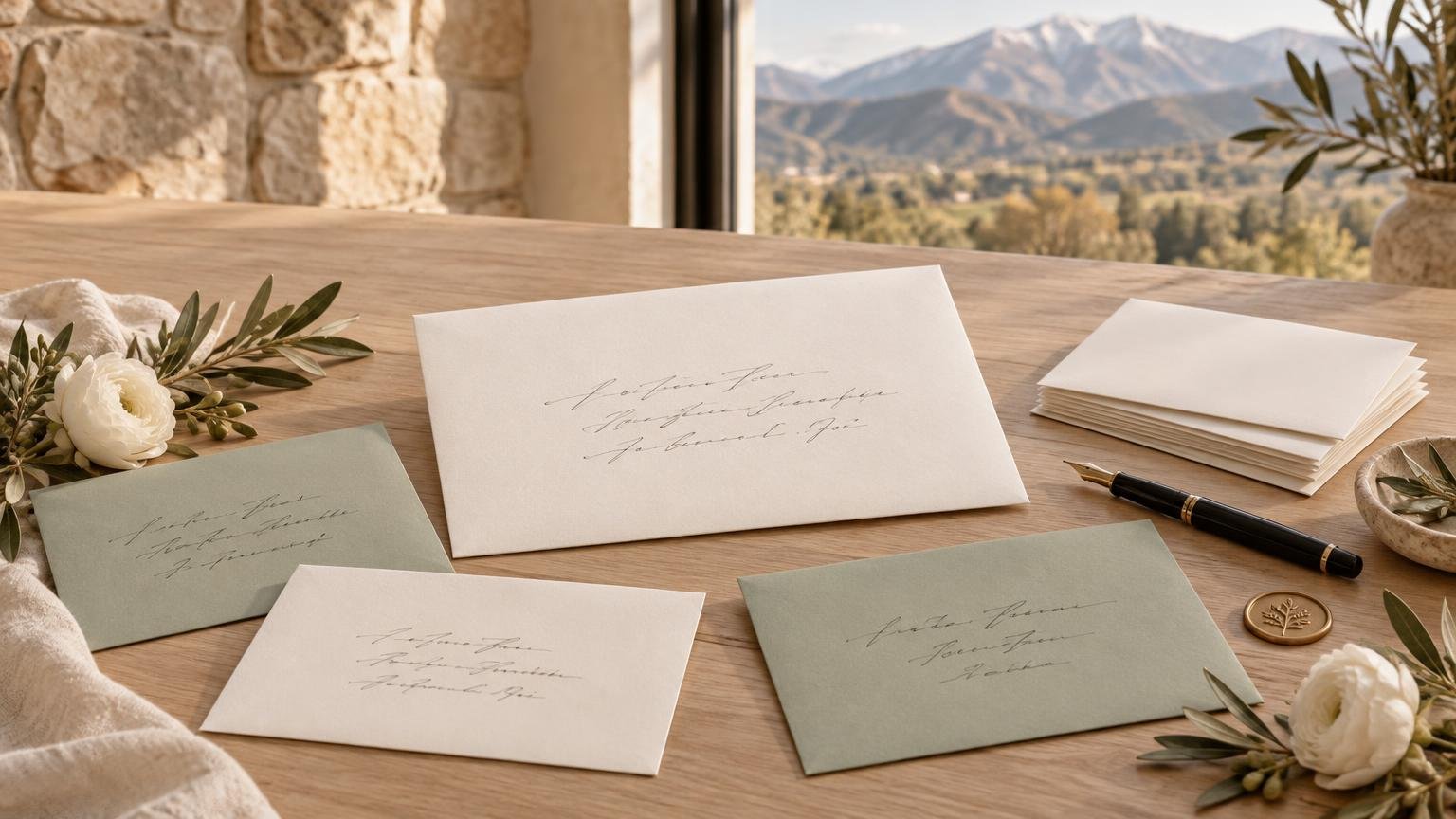
How to Address Wedding Invitations to a Family
Address a wedding invitation to a family by making it unmistakable who is invited. For a household invitation, you can use “The Martinez Family.” For a more formal approach, name the parents on the outer envelope and list every invited family member on the inner envelope. If your suite has only one envelope, put the invited children’s names beneath the parents’ names.
The most important rule is not whether you use a traditional or modern format. It is whether the names on the envelope match your guest list. “The Martinez Family” invites the entire family, while an envelope addressed only to “Mr. and Mrs. Martinez” does not include their children by default.
Choose between a household name and individual names
A collective family name is the simplest option when everyone in the household is invited and shares a surname. Write the family name on the first line, followed by the complete delivery address:
- The Martinez Family
- 1846 Canyon View Drive
- Sandy, UT 84092
Individual names are better when you want greater formality, when household members use different surnames, or when only certain children are invited. They also reduce ambiguity in blended families and households that include relatives or roommates who are not part of the invitation.
How to address a family with one envelope
If the parents and children share a surname, place the parents on the first line and the invited children beneath them. A traditional version might read:
- Mr. and Mrs. Daniel Martinez
- Sofia Martinez and Lucas Martinez
- 1846 Canyon View Drive
- Sandy, UT 84092
A modern version can state both adults’ names instead:
- Daniel and Elena Martinez
- Sofia and Lucas Martinez
- 1846 Canyon View Drive
- Sandy, UT 84092
Repeating the children’s surname is optional when it is already obvious and everyone uses the same name. Include full names when doing so prevents confusion. Emily Post’s wedding guidance says that when there is no inner envelope, invited children’s names can appear below their parents’ names on the outer envelope. Emily Post’s wedding invitation addressing guide
If you prefer collective wording, “The Martinez Family” is sufficient. Do not add “and Family” after a couple’s names unless you genuinely intend to invite the entire family. That phrase may be interpreted more broadly than you expect.
How to use outer and inner envelopes
A traditional two-envelope suite divides the job between two pieces. The outer envelope carries the formal recipient names and postal address. The inner envelope identifies precisely which members of the household are invited.
For example, the outer envelope could say:
- Mr. and Mrs. Daniel Martinez
- 1846 Canyon View Drive
- Sandy, UT 84092
The inner envelope could then say:
- Mr. and Mrs. Martinez
- Sofia Martinez
- Lucas Martinez
That structure lets the outer envelope remain formal and uncluttered while the inner envelope does the important guest-list work. Emily Post uses this same general pattern: parents appear on the outer envelope, while the parents and each invited child are named on the inner envelope.
An inner envelope does not need a mailing address because it stays inside the outer envelope. It can also use a familiar form for close relatives, such as “Aunt Martha and Uncle Bill,” if that suits your relationship and the tone of the wedding.
Families with different last names
When married parents use different surnames, give each adult a full name rather than inventing a shared family name. Either person may appear first. A formal outer envelope might read:
- Mr. John Kelly and Ms. Jane Johnson
- 72 Juniper Ridge Lane
- Park City, UT 84060
If both names will not fit comfortably on one line, move the second name to the next line. Emily Post permits the second line to begin with “and,” with either person listed first.
Name the invited children beneath the parents on a single envelope, or list them on the inner envelope in a two-envelope suite:
- Mr. John Kelly and Ms. Jane Johnson
- Avery Kelly
- Noah Johnson
Use each child’s full name when surnames differ. This is not about making the envelope more formal; it is about making the invitation clear. Avoid labels such as “The Kelly Family” if that wording inaccurately assigns one surname to everyone in the household.
The same principle applies to unmarried partners living together: name both people. Etiquette examples vary between “and” and an ampersand, but both adults should appear if both are invited. For more couple-specific formats, see how to address wedding invitations to a married couple.
When every child’s name should appear
Write each child’s name when the invitation could otherwise leave the family uncertain. Individual names are especially useful when only some children in a household are invited, children use different surnames, or an adult child receives a separate invitation.
If every member of the household is invited, you may choose between “The Nguyen Family” and a complete list of names. If only the parents are invited, address the envelope only to the parents. Do not use “and Family,” and do not list the children on an inner envelope. Addressing cannot prevent every question, but it should never create an invitation you did not intend to extend.
Separate invitations can also be sent to children rather than including them on their parents’ invitation. This can be useful for an adult child, a child living at another address or someone whose invitation includes a separate guest.
Titles, preferences and special circumstances
Traditional outer-envelope styles use titles such as Mr., Mrs., Ms. and Dr., but a guest’s actual name and title preference should take priority over a generic formula. Emily Post also recognizes Mx. as a gender-neutral title. If you do not know what a guest uses, ask rather than guessing.
You may also omit titles and write every adult’s full name, provided that choice is consistent with the rest of the invitation suite. For example, “Taylor Morgan and Jordan Lee” is direct and respectful. Consistency matters more than forcing every household into the same marital naming convention.
Professional titles may require a more specific format, particularly for doctors. Esquire should not be combined with Mr. or Ms. If a household includes a widow or widower, use the name and title that person currently uses; addressing a widowed wedding guest deserves more care than simply applying an old household formula.
Do not confuse guest names with the mailing address
Etiquette determines whose names appear on the envelope. Postal standards determine whether the envelope can reach them. USPS guidance calls for a complete delivery address, including the street address or PO Box, relevant directional information, apartment or suite details, city, state and ZIP Code. The delivery and return addresses should be on the same side of the envelope and parallel to its longest edge.
Decorative calligraphy still needs to be clear and legible. Keep the address lines aligned, leave enough contrast between the ink and envelope, and verify apartment numbers and ZIP Codes before mailing. The USPS addressing guidance is the useful authority here; wedding etiquette cannot compensate for an incomplete postal address.
Proof the household list before printing
Addressing decisions affect more than the envelope. Your invitation quantity is based primarily on households, not total attendance. A family of five usually needs one invitation suite, while an adult child at another address may need another. Build a household-based mailing list before ordering, then include extras for late additions, addressing errors and keepsakes.
Use separate spreadsheet fields for adult names, children’s names, street address, apartment or unit, city, state and ZIP Code. Add a field that records exactly who is invited. This keeps the guest-list decision separate from the formatted envelope text and makes it easier to catch an accidentally omitted child.
Before sending final artwork to an invitation-printing service, proof one example of every household type: shared surname, different surnames, children included, parents only, professional titles and long names. Make sure the longest entry fits the envelope design without shrinking the type until it becomes difficult to read.
If you are still setting conventions for the complete guest list, use the broader guide to addressing wedding invitations correctly. Once the envelopes are settled, check whether any mail-in response card also needs a pre-addressed and stamped wedding RSVP envelope.
The clearest wording is the best wording
Use “The [Surname] Family” when the entire household shares that name and everyone is invited. Name the parents and list invited children underneath when you have one envelope and want individual clarity. With inner and outer envelopes, put the formal recipient names and mailing address outside, then name every invited person inside.
For households with different surnames, skip the forced family label and write the actual names. The finished envelope should do two jobs well: tell the household exactly who is welcome and give USPS a complete, readable address. When both are clear, the etiquette is doing what it is supposed to do—helping your guests feel expected rather than making them decode the invitation.
Frequently Asked Questions
Does “The Martinez Family” include the children?
Yes. “The Martinez Family” signals that the whole family is invited. Addressing the envelope only to the parents does not include their children by default.
How do you list children when there is only one envelope?
Put the adults’ names on the first line and the invited children’s names beneath them. Use full names when needed for clarity.
How do inner and outer envelopes work for a family?
Use the outer envelope for the formal recipient names and mailing address. On the inner envelope, name the parents and each invited child so the guest list is unmistakable.
How should you address a family with different last names?
Write each adult’s full name instead of creating a shared family label. Either adult may appear first, and invited children should be named individually, with full names where clarity requires them.
What if only some of the children are invited?
Name only the adults and children who are invited. Avoid “The [Surname] Family” and “and Family,” because both can imply that the entire household is welcome.
Should an adult child receive a separate wedding invitation?
A separate invitation is useful when an adult child lives elsewhere or has a distinct invitation that includes a guest. Children may also receive separate invitations rather than being included with their parents.
References
- How to Signal "No Children" at Your Wedding — Emily Post
- Addressing Wedding Invitations 101: Our Comprehensive Guide — Emily Post
- How To Address An Envelope or Letter — Emily Post
- Reuters: Be a Gracious Wedding Guest, Not a Royal Pain — Emily Post
- Addressing Your Mail | Postal Explorer
- Publication 28 – Postal Addressing Standards