Do You Put a Stamp on the Wedding RSVP Envelope?
Yes—if you expect guests to mail their wedding RSVP cards back, the customary and guest-friendly choice is to place postage on each pre-addressed reply envelope. It removes a small obstacle and makes responding as easy as completing the card, sealing the envelope, and dropping it in the mail.
If you are asking, “do you put a stamp on wedding RSVP envelope mail?” remember that this is etiquette rather than a universal postal mandate. You may send an unstamped envelope, but the guest must then obtain and apply the correct postage. No return stamp is needed when your primary response method is a wedding website, QR code, email, text, or phone number.
Why the RSVP envelope is usually stamped
The host is asking for a response, so providing the addressed envelope and its postage is a practical courtesy. It also reduces the chance that a guest will set the card aside because no stamp is available. That can be especially helpful when you need a reliable head count for catering, seating, transportation, or separate ceremony and reception arrangements.
An unstamped, pre-addressed reply envelope is permitted. USPS describes this arrangement as Courtesy Reply Mail: the respondent places the correct postage on the envelope or postcard before mailing it. This is different from Business Reply Mail, a permit-based service under which the recipient pays applicable postage and fees. Most personal wedding RSVP envelopes are not Business Reply Mail. USPS guidance on Courtesy Reply Mail explains the distinction.
Calling an envelope “postage paid” or printing a reply-mail design on it does not create prepaid postage. Unless you have arranged an applicable USPS service, use valid postage or make it clear that the guest must add it.
Choose the setup that matches your response method
The right arrangement depends on how you actually want guests to respond. Pick one primary method and make it unmistakable on the invitation, RSVP card, or details insert.
| Response method | What to include | Who handles postage |
|---|---|---|
| Domestic mailed RSVP | Response card plus a pre-addressed reply envelope | The couple or host should normally pre-stamp the envelope |
| Unstamped mailed RSVP | Response card plus a clearly addressed reply envelope | The guest obtains and applies the correct postage |
| Online RSVP | Website address, QR code, or clear digital instructions | No reply-envelope postage is needed |
| Hybrid RSVP | A mailed card and a clearly labeled digital alternative | Stamp mailed reply envelopes; digital responders need no postage |
| International guest | A digital option, or country-specific mailing instructions | Do not assume a U.S. stamp prepays mail posted abroad |
Mailed domestic responses
For guests mailing replies within the United States, address the return envelopes before assembling the suite and add enough postage for the finished response piece. The return address will often be the person tracking replies, which does not have to be the same person whose return address appears on the invitation's outer envelope.
Online and hybrid responses
A digital RSVP can replace the reply card and envelope completely. Print the wedding website, email address, phone number, or QR code with a clear deadline and a direct instruction such as “Please respond by June 10 at…” A hybrid arrangement gives guests both a stamped card and a digital option.
Avoid presenting several methods without identifying the preferred one. When guests can respond through a card, website, text, email, and phone call with equal emphasis, replies may reach different people and become harder to track. A simple line such as “Reply online, or return the enclosed card” establishes a clear process.
If a mailed response fits your plans, you can order printed RSVP cards and coordinated invitation stationery as one consistent suite. Finalize the wording, response deadline, meal questions, guest-count fields, and return address before approving the proof.
How much postage does a wedding RSVP envelope need?
Do not determine postage solely by counting stamps. The correct amount depends on the completed mailpiece and the value of the postage already applied. USPS says letter postage is affected by weight and shape, while its retail standards also account for dimensions and machinability.
Postal prices can change, so check the current USPS Notice 123 price list shortly before buying postage. Do not rely on a price printed in an old wedding checklist or saved social-media post.
For the most useful check, assemble one reply exactly as a guest will mail it. Put the card inside the actual envelope, close it in the intended way, and have that finished sample weighed and evaluated. Repeat the check if you later change the paper, add an insert, or decorate the envelope.
- Confirm the finished weight rather than weighing an empty envelope.
- Check the envelope's length, height, thickness, and proportions.
- Make sure the piece is flexible and evenly shaped.
- Include every item the guest will return.
- Test the intended closure, seal, or exterior decoration.
- Verify the current rate before applying postage to the full batch.
Square, rigid, and decorated reply envelopes need extra attention
A small reply envelope is not automatically eligible for the lowest letter rate. USPS identifies several characteristics that can make a letter nonmachinable, including square or out-of-range proportions, rigidity, uneven thickness, lumpiness, certain closures, and an address printed parallel to the shorter edge. A nonmachinable piece may require additional postage.
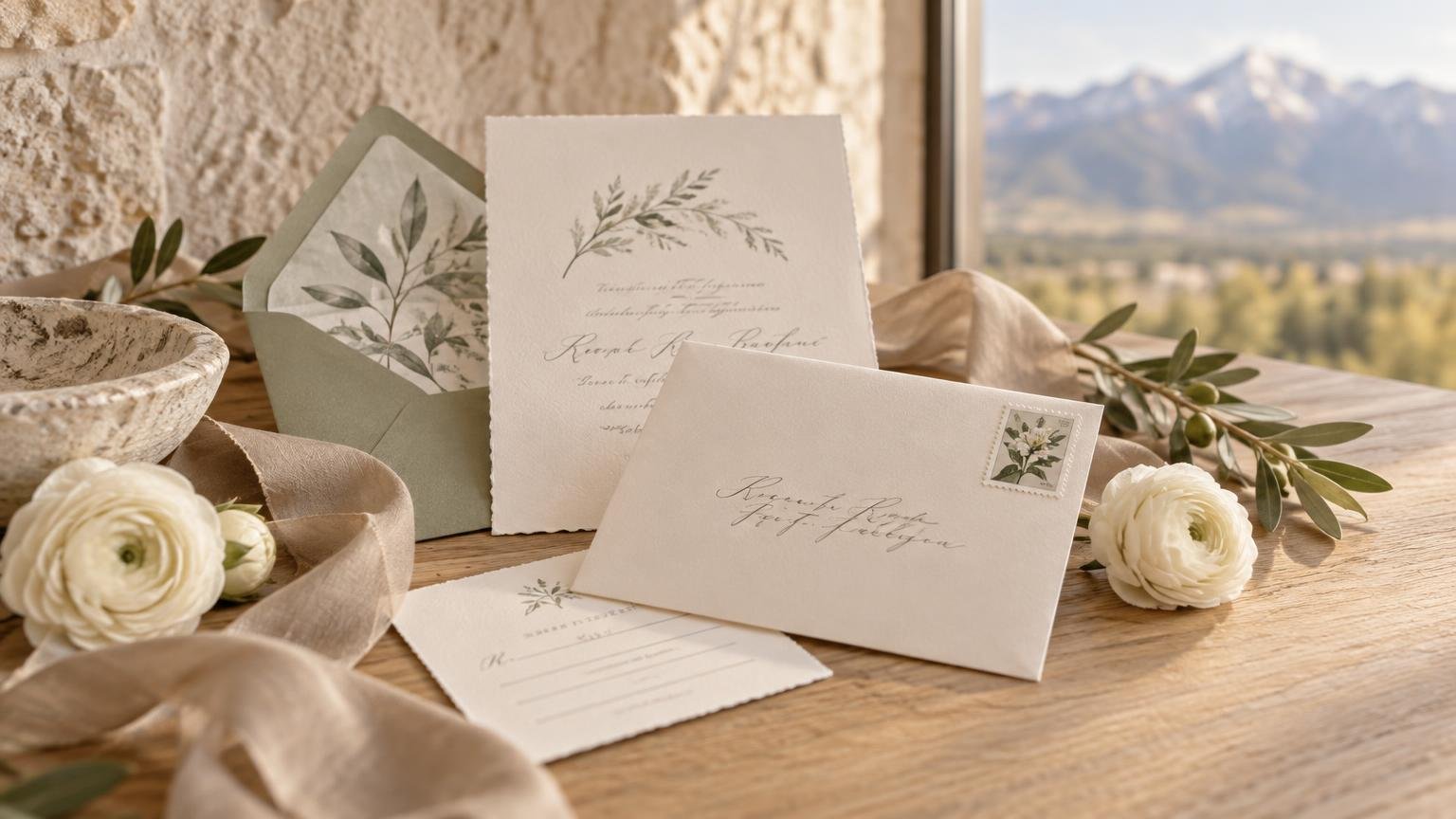
Wax seals, bows, ribbon knots, thick embellishments, clasps, and raised exterior decorations deserve an in-person check because they can alter thickness, flexibility, or surface uniformity. A decorative stamp-shaped sticker is not postage, and placing an envelope seal near the postage area should not obscure the stamp or addressing.
If the reply design is unusual, take a finished sample to a Post Office before purchasing stamps for every suite. A simpler rectangular envelope is generally the easier choice when dependable processing and straightforward postage matter more than novelty.
Handle international wedding guests differently
Do not assume a U.S. stamp on the reply envelope will cover an RSVP posted from another country. Postal stamps are issued for prepayment within the country or territory that issued them, and the guest's local postal operator determines the applicable outbound postage. USPS international letter prices describe mail sent from the United States to another country; they do not establish the price for a reply traveling in the opposite direction.
The simplest solution is to give international guests a digital response method, even if domestic guests receive stamped reply envelopes. A website, email address, or direct message avoids asking an overseas guest to locate the correct local postage for a small reply card.
If a physical international reply is important, verify the arrangement for each origin country rather than trying to solve it with ordinary U.S. postage. Send the guest clear instructions and enough time for international delivery.
Address and proof the reply envelope before assembly
A stamped RSVP envelope should also be pre-addressed. Guests should not have to guess where the card goes or copy an address from another part of the invitation. Use the address of the person responsible for recording responses, and proof the name, street address, unit number, city, state, and ZIP Code carefully.
Keep response planning connected to the rest of the suite. The invitation establishes the finalized event and RSVP details, while a save-the-date serves an earlier purpose; the distinction is covered in this guide to save-the-dates and wedding invitations. If postage is affecting the budget, review the number and size of inserts along with the paper and envelope choices rather than treating stamps as an afterthought. These are among the practical decisions in saving money on wedding invitations without making them look cheap.
A final RSVP-envelope checklist
- Choose one primary response method and state it clearly.
- If guests will mail domestic replies, pre-address and normally pre-stamp each envelope.
- Assemble one finished response piece with the real card, envelope, closure, and decorations.
- Check its weight, dimensions, thickness, flexibility, and machinability.
- Confirm the current USPS price before buying or applying the full batch of postage.
- Give international guests a convenient digital option.
- Proof the response deadline and return address before printing.
- Keep a master guest list so mailed and digital replies are recorded in one place.
The practical answer is simple: stamp a domestic wedding RSVP envelope when you are asking the guest to return a physical card. Use a clear digital route when no card is required, and make special arrangements for guests responding from abroad. Most importantly, verify postage using one fully assembled sample rather than assuming every small envelope mails at the standard letter rate.